Ecommerce fulfillment automation helps you ship more orders with less stress. It replaces manual steps with smarter workflows and better data. As a result, you improve speed and accuracy without burning out your team.
The market is growing fast. In 2024, the ecommerce fulfillment services market was worth $114.8 billion. By 2033, it is expected to reach $279.7 billion. That is a growth rate of 10.4% per year.
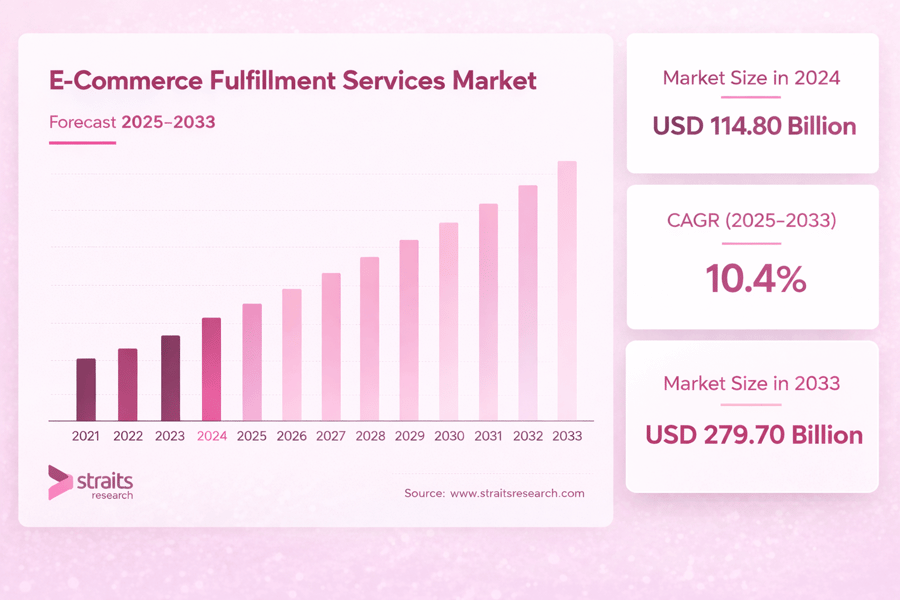
The report points to several clear drivers:
- More online retail orders
- Higher demand for fast delivery
- More cross-border shipments
- Greater use of third-party logistics
- More complex warehouse operations
In practice, this means more pressure every day. More orders. More SKUs. Less room for error.
Customers want fast delivery, correct orders, and live tracking. At the same time, teams face higher carrier costs, hard-to-fill roles, and tight ship-by deadlines. Even a small growth can break a weak process.
What you will understand after reading
- What fulfillment automation includes in modern warehouses
- How warehouse automation differs from basic software
- The warning signs that it is time to invest
- Which tools improve picking, packing, and shipping the fastest
- How to estimate ROI with clear KPIs
- How to roll out changes without hurting daily order flow
The objective is straightforward. Build a fulfillment process that scales with demand, maintains accuracy, and reduces preventable friction as volume grows.
What Ecommerce Fulfillment Automation Means in Modern Operations
Ecommerce fulfillment automation means orders move through the warehouse by system rules, not manual choices. Routing, pick lists, and label creation happen inside connected software. Nothing is managed step by step by hand.
The goal is accuracy at scale. When order volume grows, manual checks slow things down and cause mistakes. Automation handles routine tasks like routing and pick list creation. As a result, your team spends less time fixing errors.
Ecommerce Fulfillment Automation Is a System, Not a Single Tool
Many people think automation means robots. In practice, it usually starts with connecting the systems you already have. The foundation is clear routing logic, accurate inventory data, and defined rules inside your order and warehouse platforms.
When these are connected, results become more predictable. Inventory updates in real time. Problems appear right away. Customer notifications go out automatically.
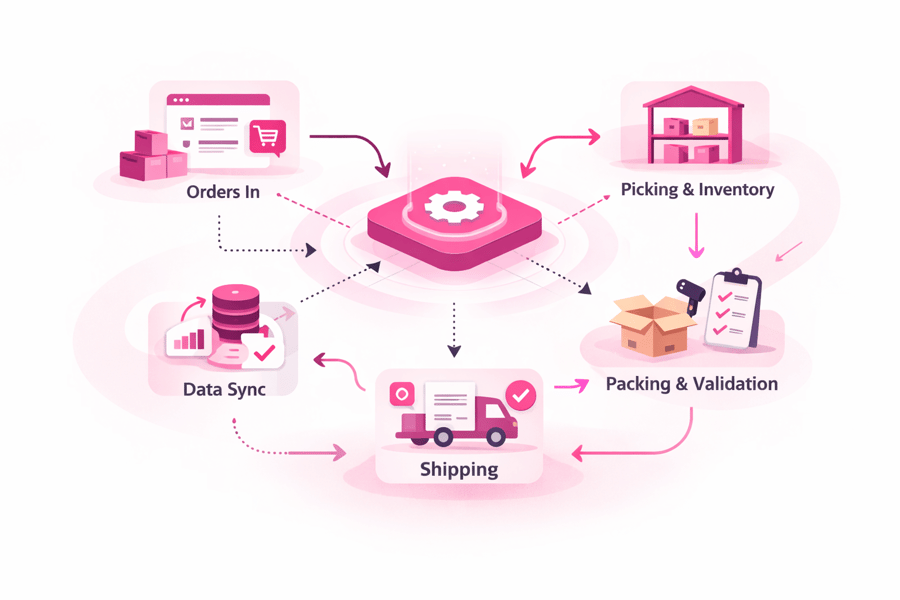
The real value is coordination. Automation works when order data, stock levels, and shipping logic all run inside one structured workflow.
Fulfillment Automation: Where It Shows Up on the Warehouse Floor
Ecommerce warehouse automation shows up in the daily work your team does. For example, it can guide pickers to the best route, confirm items with barcode scans, and suggest the right box size. It can also rate-shop carriers and choose the best service level in seconds.
- Order routing based on location, stock, and cutoff times
- Pick-to-light, scan-to-verify, and mobile picking workflows
- Automated packing checks to reduce wrong-item shipments
- Label creation, tracking updates, and carrier selection
To coordinate these automated steps across channels and inventory, see how an order management system supports end-to-end ecommerce success.
When to Invest: Triggers That Signal You Need Ecommerce Fulfillment Automation
Teams rarely make a strategic decision to implement ecommerce fulfillment automation at once. The need becomes visible through operational pressure. Small inefficiencies accumulate. Delays become routine. Error rates rise. Margins tighten. When these patterns repeat, automation becomes a logical operational step rather than an optional improvement.
The following triggers typically indicate that ecommerce fulfillment automation should be seriously evaluated.
Order volume exceeds workflow capacity
If additional staff does not translate into higher throughput, the limitation is the process itself. During promotions, weekends, or peak seasons, orders accumulate faster than they move through picking and shipping. Overtime increases and carrier cut-off times are missed.
Error rates begin to affect profitability
Incorrect items, missing inserts, and labeling mistakes generate reshipments and refunds. The direct financial impact is measurable, but the long-term effect on customer retention is often greater.
Labor becomes the primary constraint
Hiring cycles slow down operations. Training requires supervision. Staff turnover interrupts consistency. Supervisors spend more time managing schedules than improving performance.
Inventory accuracy becomes unreliable
Frequent discrepancies between system records and physical stock create operational instability. Overselling, split shipments, and delayed fulfillment often originate from inconsistent data capture.
Shipping costs rise due to reactive decisions
When carrier cut-off times are missed, faster and more expensive services are selected to compensate. Rate comparisons happen under pressure. Packaging choices vary from order to order.
Additional operational indicators often include:
- Backlogs during standard volume days
- Low picks per labor hour
- Growing return rates caused by fulfillment mistakes
- Increased customer support inquiries related to shipping status
- New sales channels with a strain on existing warehouse workflows
To sustain those gains, pair automation with inventory software for a warehouse that unifies stock visibility, workflows, and replenishment across every sales channel.
Core Technologies Behind Ecommerce Warehouse Automation
Ecommerce fulfillment automation relies on a set of connected tools that increase speed and reduce operational errors. There is no need to implement every system at once. The focus should be on removing the largest bottlenecks first.
At a high level, ecommerce warehouse automation connects decision-making software with physical warehouse execution. Systems determine what needs to happen. People and equipment execute tasks according to defined logic.
Management system in ecommerce warehouse automation
A WMS tracks where inventory sits and who should pick it up. It updates stock levels in real time and enforces basic rules like FIFO or lot tracking. When inventory data is reliable, fewer orders get delayed because something “looked available” but was not.
Order management and smart routing
An OMS collects orders from all channels and decides where they should be fulfilled. It prevents one zone from being overloaded while another has capacity. In ecommerce fulfillment automation, routing is structured rather than reactive.
Data capture in ecommerce fulfillment automation
Scanning confirms that the correct item has been picked and packed. RFID helps speed up receiving and counting in larger catalogs. Without consistent data capture, automation cannot stay accurate.
Pick and pack workflow optimization
Tools such as mobile picking apps and cartonization software guide how items are selected and packed. The result is fewer mis picks and more consistent packaging decisions.
Material handling and robotics
Conveyors and automated storage systems reduce unnecessary walking. Mobile robots bring products to workstations instead of sending employees across the warehouse.
Shipping automation and carrier logic
Shipping systems compare rates, generate labels, and automatically update tracking. Carrier selection follows defined rules instead of last-minute decisions.
For stable operations, ecommerce warehouse automation should work alongside a reliable inventory management system. It supports accurate stock control and replenishment planning.
Tip: Choose tech that makes data sharing easy, so each upgrade strengthens the next.
Tip: Standardize item labels and locations first; automation works best with clean inputs.
To keep these automation gains consistent, pair your tools with a robust inventory management system that improves stock accuracy and replenishment decisions.
Where Ecommerce Fulfillment Automation Delivers the Biggest Wins
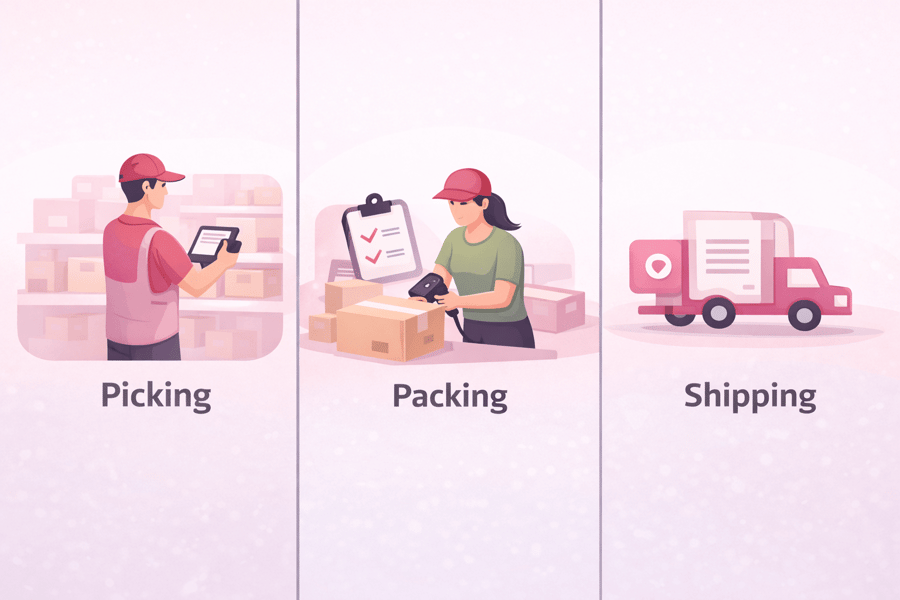
Picking, packing, and shipping define how fulfillment actually performs. Delays, errors, and rising costs usually originate in these stages. For that reason, ecommerce fulfillment automation delivers the fastest and most measurable improvements here.
Picking: Where inefficiency is easiest to see
Picking uses the most warehouse labor. As volume grows, problems become obvious. Workers walk more. Manual double-checks slow everything down. Workloads become uneven across zones. Automation adds structure to picking. Clear routing cuts wasted movement. Real-time scan confirmation lowers mispicks. Balanced task allocation keeps output steady during peak periods.
Packing: Where small mistakes cost real money
Packing errors often look minor. But the financial impact adds up. One wrong item means a reshipment. An oversized box raises your shipping cost. Inconsistent packaging hurts your brand. In an automated setup, the packing station is a control point. Order contents are checked before sealing. Box selection follows set rules. Returns go down, and consistency goes up.
Shipping: Where pressure peaks every day
Carrier cutoffs are fixed. Manual rate comparisons take time. Address errors show up at the worst moment. Integrated shipping logic gives you control. Carrier selection follows defined rules. Labels generate automatically. Tracking syncs in real time with no extra steps.
Across all three stages, automation reduces variation and increases reliability. Fulfillment shifts from reactive to controlled.
To see what’s next beyond today’s gains, explore how automated fulfillment is evolving in The Future of Automated Fulfillment Solutions.
Integrations That Matter: Connecting Ecommerce Fulfillment Automation
Ecommerce fulfillment automation depends on how well systems communicate. Clean, real-time data flow keeps operations stable. Weak integrations create delays, duplicate entries, and missed shipping deadlines.
Clear integration logic allows growth without operational noise. Orders move once. Data updates once. Every system reflects the same status. Mapping the order journey from checkout to delivery is the first practical step. Each handoff must pass structured data forward without reentry or correction.
WMS integration: ecommerce warehouse automation
A Warehouse Management System holds inventory data and task-execution logic. Ecommerce fulfillment automation relies on real-time updates for receiving, putaway, picking, packing, and cycle counts. Accurate stock data prevents overselling and unexpected backorders.
Automation signals such as pick confirmations, scan events, and exception flags should flow back into the WMS. Consistent updates support labor planning, replenishment logic, and reporting accuracy.
OMS integration: routing and service commitments
An Order Management System defines where orders are fulfilled and what delivery promises are made. When OMS logic aligns with warehouse execution, routing decisions reflect real inventory levels and operational capacity.
Status updates must return to the OMS at key stages, including picking, packing, shipping, and cancellations. Customer support teams depend on accurate visibility. Storefront tracking depends on timely synchronization.
Carrier integration: cost, compliance, visibility
Carrier systems must support rate comparison, compliant label generation, and fast tracking updates. Ecommerce fulfillment automation selects services based on cost targets, delivery speed, and defined shipping rules.
Live rate access improves decision-making before label creation. Address validation reduces failed deliveries and chargebacks. Tracking events should sync automatically to the OMS and storefront to maintain customer visibility.
Operational resilience also matters. Alerts for API failures, label errors, and inventory mismatches protect workflow continuity. Ecommerce warehouse automation performs reliably only when integration monitoring is in place.
In-House vs 3PL: How Ecommerce Fulfillment Automation Changes the Decision
Today, system capability matters just as much as square footage. The right decision depends on which model can best standardize your process and scale your output. Compare both options against the same performance goals, not just cost per order.
When in-house automation makes sense
In-house works best when control is critical. Custom branding, kitting, or special packaging often needs close oversight. With automation, internal teams can cut walking time, reduce errors, and extend shipping windows. This model is stronger when volume is steady and seasonality is predictable. But long-term success requires ongoing investment in maintenance, training, and reporting.
When a 3PL is the better choice
A 3PL gives you speed without a long internal build. That matters when growth is uncertain or geographic expansion is urgent. Many 3PLs already run automation across picking, packing, and carrier selection. A 3PL also helps when you need multi-warehouse coverage. Shifting fixed warehouse costs to variable fees can improve cash flow. Carrier discounts and later cutoffs may also be easier to get through an established provider.
How automation changes the comparison
The question is no longer just about space. It is about integration speed and operational reliability. Ask how quickly each option connects to your store, OMS, and carrier network. The better choice is the one that meets your service level targets. Automation makes both paths viable. The difference is execution discipline and system alignment.
Cost, ROI, and KPIs for Ecommerce Warehouse Automation
Cost and ROI determine whether ecommerce warehouse automation becomes a priority. Before investing, you need clarity on where money goes and how it returns. The right approach is simple. Break costs into clear categories. Then connect each category to a measurable outcome.
What costs to expect
Budgets for ecommerce warehouse automation include both upfront and ongoing expenses. Initial investments may look high. However, many savings appear within months if implementation is disciplined.
Costs usually fall into five groups:
- Hardware. Scanners, label printers, packing stations, conveyors, sorters, or robotics equipment.
- Software. WMS or OMS modules, shipping platforms, rule engines, and reporting tools.
- Integration. Connections between ecommerce platforms, carriers, and inventory systems.
- Implementation. Process design, configuration, testing, and team training.
- Ongoing support. Licenses, maintenance, system updates, and equipment servicing.
A complete view prevents underestimation and protects ROI assumptions.
How to calculate ROI (without complex math)
Start with your current numbers. Measure orders per day, labor hours, error rates, and shipping spend. Then, estimate the improvement after ecommerce fulfillment automation using realistic assumptions.
Focus on four impact areas:
- Labor efficiency. Fewer touches per order and reduced overtime lower direct labor cost.
- Shipping optimization. Smarter rate selection and fewer address errors reduce carrier spend.
- Inventory accuracy. Better data lowers stockouts and reduces excess safety stock.
- Revenue impact. Faster shipping and fewer errors increase repeat purchases.
When improvements are quantified in weekly terms, payback becomes visible and predictable.
KPIs that prove performance
KPIs must connect operations to financial outcomes. Review them consistently by shift and by warehouse zone. That way, performance issues become clear early.
Key metrics include:
- Order cycle time from checkout to shipment.
- Pick rate is measured as lines per labor hour.
- Pack time per order and packing accuracy.
- Mis-pick rate and overall order accuracy.
- On-time ship rate and carrier scan compliance.
- Fully loaded cost per order.
- Return rate caused by fulfillment errors.
- Inventory accuracy and shrinkage levels.
Track these KPIs before rollout and again after implementation. Clear comparison builds confidence in ecommerce warehouse automation and highlights where further optimization is needed.
Implementation Roadmap: Rolling Out Ecommerce Fulfillment Automation with Minimal Disruption
Start by defining what success looks like. Faster pick rates, fewer errors, or later carrier cutoffs are all measurable targets. Clear goals prevent wasted spending.
Pick three to five KPIs: pick rate, order cycle time, error rate, and labor cost per order are good starting points. Document your current workflow in full, including exceptions and returns. Decide which steps stay manual and which move to automation first.
Step 2: Clean your data and test connections
Bad data breaks good automation. Review your SKU master, bin locations, carton rules, and carrier settings before you go live. Test your WMS, OMS, and carrier integrations in a controlled environment. Clean inputs reduce errors after launch. Reliable connections keep automation running without interruption.
Step 3: Pilot in one zone
Do not launch across the whole warehouse at once. Start with one zone, one shift, or one order type. This keeps daily shipping stable while you validate your workflows. Use real SKUs and order types. Run parallel processes for comparison. Log issues daily and adjust quickly. When the software logic is stable, expand it to hardware.
Step 4: Train, then standardize
Train supervisors first. Then train frontline staff with simple job aids. Supervisors can coach on the floor and keep speed consistent. Build standard procedures for picking, packing, and handling exceptions.
Step 5: Scale in waves and measure
Expand by zone, product family, or volume tier. Review KPIs weekly and adjust rules, slotting, and labor plans as needed. Treat automation as an ongoing program, not a one-time project.
Common Pitfalls and How to Avoid Them in Ecommerce Warehouse Automation
Most automation problems can be prevented. Here is what to watch for.
Pitfall 1: Automating a broken process
If your pick paths, bin labels, or replenishment rules are messy, automation makes the mess move faster. Fix the basics first. Standardize locations, clean your SKU data, and document each step before adding new tools.
Pitfall 2: Choosing the wrong technology
Some systems work best with high-volume, single-SKU orders. Others handle multi-line carts better. The wrong choice creates new bottlenecks. Use real order history, peak-day volume, and SKU dimensions to validate your requirements.
Pitfall 3: Weak integrations
Automation depends on synchronized data across your WMS, OMS, and carriers. Test edge cases like split shipments and address changes before full rollout. Set up monitoring alerts to catch problems early.
Pitfall 4: Underestimating training
People make automation work, not just machines. Rushed training leads to workarounds and missed scans. Train by role. Use simple SOPs at the workstation. Assign floor champions for the first few weeks.
Pitfall 5: Ignoring maintenance and growth
Automation needs uptime, spare parts, and a clear support plan. A system built only for today can break under tomorrow’s volume. Schedule maintenance, track downtime, and plan capacity for peak seasons and new sales channels.
Conclusion
Ecommerce fulfillment automation improves stability when implemented with care. Picking, packing, and shipping become more predictable. Error rates drop. Throughput stabilizes.
But results depend on alignment between tools, data, and process discipline. Automation should grow in phases. Clear KPIs, a structured rollout, and consistent measurement protect both service levels and profit.
Your next step
If you want a practical plan, map your current workflow end-to-end. Identify the top three bottlenecks, then prioritize changes that remove manual steps. Consequently, you get quick wins without disrupting peak season.
- Audit your data: SKUs, order mix, and carrier performance.
- Choose one process to automate first (picking, packing, or shipping).
- Set baseline KPIs and review them weekly for 60 days.
Ready to move forward with ecommerce fulfillment automation?
Schedule a warehouse walkthrough, gather your KPIs, and build a phased rollout plan. When you start small and scale with proof, you ship smarter and grow with confidence – especially when your strategy is aligned with strong ecommerce warehouse management that keeps inventory, labor, and fulfillment fully synchronized.
Frequently Asked Questions
How to automate your ecommerce store for order fulfillment
Start by connecting your ecommerce platform to a fulfillment system that syncs orders, inventory, and shipping in real time. Use automation rules for picking priorities, carrier selection, and label creation. Add barcode scanning to reduce errors, and integrate returns processing. As volume grows, consider warehouse management software and ecommerce warehouse automation tools for faster, more accurate workflows.
How automation improves order fulfillment ecommerce
Automation speeds up order routing, reduces manual data entry, and improves inventory accuracy. With ecommerce fulfillment automation, orders can flow from checkout to pick, pack, and ship with fewer handoffs, lowering error rates and labor costs. It also supports faster shipping decisions through automated carrier rate shopping, improving delivery times and customer satisfaction.
How automation improves order fulfillment in ecommerce
Automation improves consistency across every step, including inventory updates, picking, packing, and shipping notifications. It helps teams handle spikes in demand without adding proportional headcount. Many businesses combine software workflows with ecommerce warehouse automation, such as pick-to-light or barcode scanning, to increase throughput while maintaining accuracy and service levels.
How to automate fulfillment ecommerce
Map your current fulfillment process, then automate the highest-friction steps first: order import, inventory sync, shipping label generation, and customer tracking updates. Choose tools that integrate with your store, carriers, and accounting system. ecommerce fulfillment automation works best when rules are clearly defined for exceptions, backorders, and split shipments.
How to automate print fulfillment for an ecommerce store
Use a print-on-demand or print fulfillment platform that integrates directly with your ecommerce store. Orders should auto-send to the printer, trigger production status updates, and generate tracking details once shipped. Set product templates, artwork approval workflows, and quality checks to reduce reprints. This approach streamlines operations while automatically keeping customers informed.
What tools are used for ecommerce warehouse automation
Common tools include warehouse management systems (WMS), barcode scanners, mobile picking apps, and shipping software with rate shopping. For higher-volume operations, ecommerce warehouse automation may include conveyors, sortation systems, pick-to-light systems, autonomous mobile robots, and automated storage and retrieval systems. The right mix depends on order volume, SKU complexity, and space constraints.