Strong warehouse performance rarely comes from effort alone. It comes from clear numbers that show where work slows, costs rise, and service slips. That is why warehouse KPIs matter. They turn daily activity into facts that leaders can review, compare, and act on with confidence.
Many teams collect data but still miss the real story. A long list of reports does not always reveal picking delays, poor slotting, or rising labor waste. The right warehouse key performance indicators bring those issues into view fast. They connect floor activity to business results such as order accuracy, dock speed, and carrying cost.
A useful warehouse KPI does more than track output. It shows whether the operation supports customer promises and profit goals at the same time. Some warehouse metrics focus on speed. Others measure accuracy, space use, or labor consistency. Together, they create a balanced view of operational health.
That balance matters because one strong result can hide another weak one. Fast shipping means little if errors drive returns and rework. High throughput can also mask overtime pressure or poor replenishment timing. Well-chosen warehouse KPIs help teams spot tradeoffs before they grow into larger problems.
The most valuable scorecards usually combine several types of measures, including inventory KPIs, warehouse productivity metrics, and warehouse efficiency metrics. Each group answers a different question about performance. Inventory measures show stock accuracy and availability. Productivity measures reveal labor output. Efficiency measures show how well time, space, and movement support the flow of work.
When companies track warehouse KPIs with discipline, decisions become faster and more precise. Managers can see patterns early, fix root causes, and set realistic targets. Over time, better data supports steadier service, lower operating costs, and fewer surprises across the warehouse.
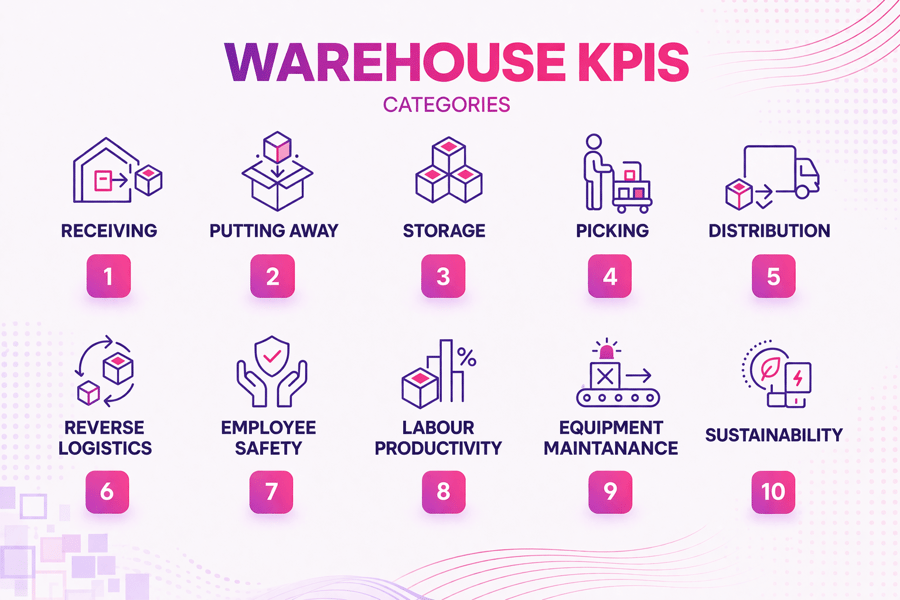
What Are Warehouse KPIs and Why Warehouse Key Performance Indicators Matter
Warehouse KPIs are measurable values that show how a warehouse performs. They track speed, accuracy, cost, labor output, and inventory flow. Strong warehouse key performance indicators turn daily activity into clear evidence of what works and what needs attention.
A useful warehouse KPI connects warehouse work to a business result. Order accuracy affects returns and customer trust. Dock-to-stock time affects product availability. Labor cost per order affects margin. Good warehouse metrics make those links visible.
Without clear measures, teams often rely on instinct or isolated reports. That creates blind spots across receiving, putaway, picking, packing, and shipping. Warehouse KPIs give leaders a shared view of performance, so problems surface earlier and decisions move faster.
Warehouse KPIs
Not every metric carries the same value. Some warehouse productivity metrics focus on output, such as lines picked per hour. Other warehouse efficiency metrics show how well resources support that output, such as labor cost, travel time, or space use. The best scorecards balance both.
Inventory KPIs add another layer of control. Inventory accuracy, stock turnover, and shrinkage reveal how well the warehouse protects working capital. These inventory key performance indicators also show whether stock data matches physical reality, which affects replenishment and order fulfillment.
Short-cycle measures matter when operations change quickly. Warehouse short-cycle metrics KPIs help managers spot issues within hours, not weeks. That matters during peak periods, labor shortages, or system changes, when small delays can spread across the day.
Warehouse KPIs matter because they replace broad opinions with specific facts. They help teams compare shifts, locations, and processes on equal terms. When the numbers stay consistent, leaders can trace root causes, set realistic targets, and improve performance with less guesswork.
Key takeaway: The right warehouse KPIs create a practical view of cost, service, and control.
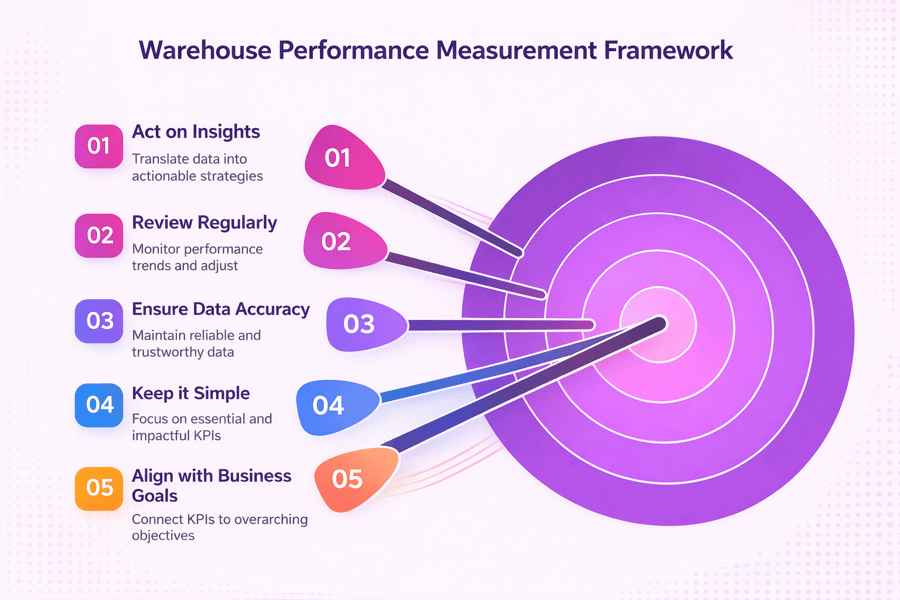
Core Warehouse Metrics Every Team Should Track
The best warehouse KPIs show how work moves through the building. Strong teams track a small set of numbers that connect speed, accuracy, cost, and service. Those measures create a clear view of daily performance without drowning managers in reports.
Warehouse metrics usually start with order accuracy, on-time shipping, and dock-to-stock time. Order accuracy shows how often the right items reach the right customer. On-time shipping reveals whether outbound work meets promised cutoffs. Dock-to-stock time shows how fast inbound goods become available for picking.
Inventory record accuracy also belongs on every scorecard. It compares system counts with what sits on the shelf. When this number slips, picking errors rise, replenishment slows, and planners lose trust in the data. That is why many teams treat it as one of their most important key performance indicators.
Space use and inventory turnover add another layer of insight. Space use shows whether storage areas support flow or create congestion. Inventory turnover shows how often stock sells and gets replaced over a period. Together, these inventory KPIs help teams spot slow-moving stock and crowded locations before service levels drop.
- Order accuracy reflects picking, packing, and verification quality.
- Dock-to-stock time highlights receiving delays and putaway bottlenecks.
- Inventory record accuracy supports cleaner replenishment and cycle counts.
- On-time shipping connects warehouse execution to customer promises.
- Labor cost per order shows whether output matches staffing levels.
Labor and productivity metrics
Labor cost per order and units picked per hour round out the core set. These are practical warehouse productivity metrics because they tie labor input to real output. They also support better staffing decisions during peak periods. When reviewed with error rates, they become useful warehouse efficiency metrics rather than simple speed measures.
A balanced dashboard matters more than a long list of warehouse KPIs. One warehouse KPI rarely explains a problem on its own. Teams get better answers when they compare service, labor, and inventory trends side by side. That view becomes even stronger when the data comes through a warehouse labor management system.
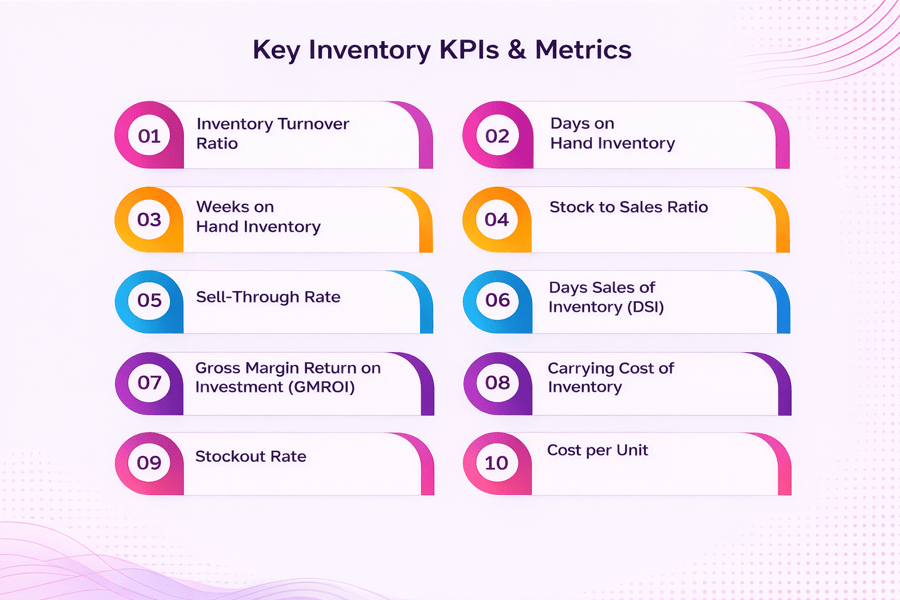
Inventory Key Performance Indicators for Better Stock Control
Strong stock control starts with accurate, timely inventory KPIs. These measures show how inventory moves, where errors appear, and how much working capital sits on the shelf. Among all warehouse KPIs, inventory data often reveals problems before labor or shipping data does.
Inventory accuracy sits near the top of every scorecard. It compares system counts with physical counts and shows whether teams can trust the data. When accuracy drops, replenishment slows, picks fail, and buyers order stock they already have.
Another key measure is inventory turnover. This metric tracks how often stock sells and gets replaced during a set period. Low turnover can point to weak demand, poor purchasing decisions, or storage space tied up by slow-moving items.
Days on hand adds useful context to turnover. It estimates how long the current stock will last at the present sales rate. This number helps planners balance service levels against carrying costs, making it one of the most practical warehouse key performance indicators.
Stock movement and risk metrics
- Stockout rate shows how often demand cannot be filled from available inventory.
- Backorder rate reflects how much demand waits because the stock arrived late or ran short.
- Shrinkage tracks losses from damage, theft, miscounts, or process gaps.
- Carrying cost links storage, insurance, and capital costs to inventory levels.
These inventory key performance indicators connect directly to service and margin. A rising stockout rate can hurt revenue fast, while high carrying costs reduce profit quietly over time. Read together, these warehouse metrics give a clearer view than any single number alone.
Cycle count performance also deserves close attention. Frequent counts reduce surprises and help teams find root causes early. Many companies pair this with other warehouse KPIs to spot trends by zone, product family, or supplier.
The best inventory scorecards stay focused on decisions, not volume. A useful warehouse KPI highlights where stock control breaks down and what financial risks follow. For teams refining their reporting, the next step often starts with practical warehouse optimization tips.
Warehouse Productivity Metrics That Reveal Labor Performance
Warehouse KPIs that track labor output show how work gets done each shift. They help leaders see whether time goes to picking, packing, travel, or rework. Strong warehouse productivity metrics connect labor cost to real output, not just hours on the clock.
Units picked per hour remains one of the clearest measures. It shows how quickly teams move through order volume under normal conditions. Cases packed per hour adds another view, especially in high-volume shipping environments. Together, these warehouse metrics reveal where pace drops and where coaching may help.
Comparing productivity by task type
Productivity data becomes more useful when teams compare output by task type. Picking speed in a small-parts zone often differs from pallet handling in bulk storage. A single average can hide those gaps. Better warehouse KPIs separate work by process, zone, and order profile.
- Labor cost per order shows whether staffing levels match demand.
- Lines picked per labor hour help measure picker performance.
- Orders processed per employee tracks output at the team level.
- Overtime percentage highlights strain, poor planning, or uneven workloads.
Accuracy also belongs in labor analysis. Fast work loses value when errors create returns, credits, or extra handling. For that reason, many teams review inventory KPIs besides labor data. This link between speed and quality gives warehouse key performance indicators more meaning.
Using trends instead of snapshots
Short-term spikes can distort a single warehouse KPI. Seasonal demand, training periods, and slotting changes all affect output. Trends over several weeks give a more reliable view. That is why many operators pair daily reports with monthly warehouse KPI reviews.
A useful labor scorecard stays focused on a few measures that reflect real work. When output, cost, and accuracy move together, managers can spot issues early and act with confidence. The clearest gains often come from better slotting, balanced staffing, and stronger warehouse management.
Warehouse Efficiency Metrics for Faster, Leaner Operations
Warehouse efficiency metrics show how smoothly work moves through the building. They focus on time, motion, space, and process waste. While warehouse productivity metrics track output per worker, efficiency measures reveal where delays, extra touches, and poor flow slow results.
Strong warehouse KPIs often start with dock-to-stock time, order cycle time, and travel distance per pick. These warehouse metrics expose friction between receiving, putaway, picking, packing, and shipping. A rising cycle time usually points to congestion, weak slotting, or uneven labor coverage.
Space use also shapes speed and cost. Storage density, bin utilization, and empty location rates show whether the layout supports fast movement. When aisles stay clear, and high-volume items sit in the right zones, teams complete more work with fewer steps.
Error-related measures belong in this group as well. Rehandle rate, mis-pick rate, and staging delays often signal process waste rather than labor effort alone. These numbers closely align with inventory KPIs because poor accuracy leads to extra moves, recounts, and shipment holds.
Core efficiency KPIs
- Dock-to-stock time shows how fast inbound goods become available.
- Order cycle time tracks the full path from release to shipment.
- Pick-path efficiency reflects travel waste within the warehouse.
- Space utilization indicates whether storage supports flow or creates bottlenecks.
The most useful warehouse key performance indicators link speed, cost, and accuracy. A faster pick rate means little if packing errors rise. Better warehouse KPIs balance throughput, labor time, and quality so managers can see real operational health.
Short review cycles keep these measures practical. Daily checks catch sudden slowdowns, while weekly trends reveal process issues that need layout, staffing, or system changes. Clear visibility across these warehouse KPIs becomes much stronger with reliable warehouse inventory tracking.
How to Choose the Right Warehouse KPI for Your Business Goals
The right warehouse KPIs depend on the result the business needs most. A fast-growing operation may focus on order cycle time and dock-to-stock speed. A mature site may care more about labor cost, space use, and order accuracy.
Connecting KPIs to business outcomes
Strong warehouse key performance indicators connect daily work to a clear business target. Revenue goals often point to shipping speed, fill rate, and backorder levels. Margin goals usually point to picking cost, damage rate, and overtime hours.
Choosing KPIs that drive decisions
Each warehouse KPI should answer one decision, not create a larger report. If a metric does not change staffing, process design, or system settings, it has limited value. Good warehouse metrics help managers spot issues early and act with confidence.
A useful way to choose warehouse KPIs is to group them by goal:
- Service goals often rely on on-time shipment rate, order accuracy, and return rate.
- Cost goals often rely on labor cost per order, storage cost, and equipment downtime.
- Inventory goals often rely on stock accuracy, days on hand, and shrinkage.
- Growth goals often rely on capacity use, throughput, and receiving speed.
Balance matters because one metric can distort another. A team chasing speed alone may raise error rates. That is why many companies pair warehouse productivity metrics with warehouse efficiency metrics and quality measures.
Data quality also shapes the value of warehouse KPIs. A clean scan process creates reliable counts and timestamps. Weak data entry turns even the best inventory KPIs into guesswork.
Short review cycles keep the metric set relevant. Seasonal peaks, new channels, and product mix changes can shift priorities fast. The best inventory key performance indicators still need context from labor plans, slotting rules, and warehouse layout planning.
Warehouse Short-Cycle Metrics KPIs and When to Use Them
Warehouse KPIs often focus on daily or weekly results. Short-cycle measures track performance by hour, shift, or task block. They help managers spot issues before they affect outbound volume, labor cost, or service levels.
When short-cycle KPIs are most useful
Warehouse short-cycle metrics KPIs work best in fast-moving sites. E-commerce, retail replenishment, and high-SKU operations depend on quick feedback. A delay at 9 a.m. can turn into missed carrier cutoffs by afternoon.
Key short-cycle metrics to track
These warehouse metrics usually track pick rate, dock-to-stock time, order cycle time, replenishment response, and trailer turn time. Many teams also monitor scan compliance and exception volume during each shift. Short intervals make trends easier to see and easier to correct.
Supporting real-time decision making
Labor planning is one strong use case for warehouse KPIs. If productivity drops in one zone, supervisors can move staff before the backlog grows. That makes short-cycle data different from monthly reports, which explain problems after the fact.
Impact on inventory control
Inventory KPIs also benefit from this approach. Short cycle counts can reveal receiving errors, slotting issues, or repeated mis-picks within hours. Teams that review inventory key performance indicators more often tend to reduce stock adjustments and urgent recounts.
External benchmarks can help frame what good looks like. Many operations leaders compare their internal numbers against references such as Key Warehouse Performance Metrics: The 3PL’s Guide when reviewing shift-level trends. The benchmark matters less than the speed of response.
Not every operation needs the same level of detail. A small warehouse with a stable order flow may rely on daily summaries. A high-volume site with tight shipping windows usually needs short-cycle data tied to labor, inventory, and equipment activity.
Warehouse key performance indicators become more useful when teams match them to decision speed. Short-cycle measures support same-day action, while broader warehouse efficiency metrics support planning over weeks or months. The best results come when both views are integrated within an automated warehouse control system.
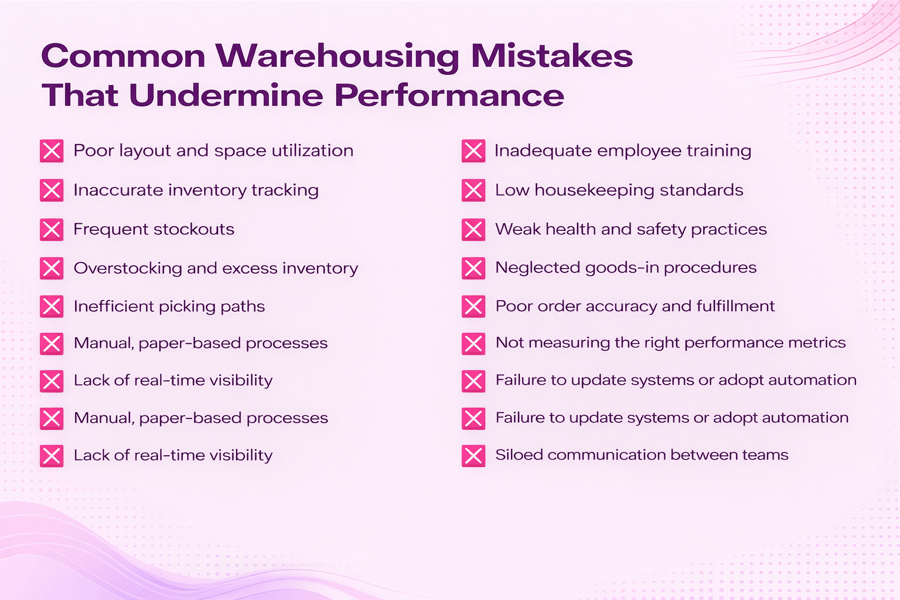
Common Mistakes When Tracking Warehouse KPIs
Many teams track too many numbers and miss the few that matter. A crowded dashboard hides weak spots and slows decisions. Strong warehouse KPIs connect directly to cost, service, and throughput.
Poor data quality issues
Another common problem starts with poor data quality. If scans are missed or timestamps vary, warehouse metrics lose value fast. Leaders then question the numbers instead of fixing the process behind them.
Measuring results without drivers
Some operations track results without tracking the drivers behind them. Order accuracy may fall, yet no one reviews pick path time or replenishment delays. That gap makes warehouse key performance indicators harder to act on.
Misleading benchmarking
Benchmarking also creates trouble when comparisons ignore context. A high-volume eCommerce site and a spare-parts warehouse work at different speeds. Articles such as 40 KPIs Businesses Must Track to Gauge Warehouse Performance can help frame options, but each warehouse kpi still needs business context.
Reviewing KPIs too infrequently
Teams often review monthly totals and miss daily shifts. That approach weakens response time when labor, slotting, or receiving starts to slip. Shorter review cycles make warehouse KPIs more useful, especially when paired with warehouse productivity metrics and warehouse efficiency metrics.
Over-focusing on labor output
Another mistake appears when managers track labor only by output. Units per hour matter, but they do not explain quality or rework. Balanced scorecards that include inventory KPIs and error rates give a clearer view of performance.
Lack of KPI ownership
Warehouse KPIs also fail when ownership stays vague. If no one owns a metric, no one explains the cause of change. Clear accountability turns reports into action and keeps trend reviews grounded in facts.
The best reporting keeps measures simple, accurate, and tied to decisions. A smaller set of trusted warehouse KPIs usually beats a larger set no one uses. Better visibility often starts with reliable inventory software for the warehouse.
How to Turn Warehouse Metrics Into Actionable Improvements
Data creates value when teams use it daily. Warehouse KPIs help when each metric shows a clear cause and next step. A rise in errors may point to poor slotting or training. A faster dock-to-stock time may show that changes work.
Use a small set of KPIs. Too many reports slow down decisions. Most teams need only a few key metrics like inventory, labor, and order accuracy.
Context matters. One bad day means little. Trends show real issues. Review KPIs by shift or zone to spot problems early.
- Compare results with a baseline.
- Fix one issue at a time.
- Track the result.
Balance speed with quality. Fast work has no value if errors grow. Review KPIs often and assign clear ownership to drive results. Lasting gains come from consistent follow-up, clear accountability, and accurate inventory tracking.
Conclusion
Warehouse KPIs matter when they connect daily work to business results. The strongest teams track a small set of numbers that show speed, accuracy, cost, and service. That mix gives leaders a clear view of what slows the warehouse and what drives steady gains.
Useful warehouse key performance indicators often span several areas at once. Inventory KPIs show stock accuracy, turns, and carrying costs. Warehouse productivity metrics reveal labor output, while warehouse efficiency metrics highlight wasted time, travel, and rework.
Good measurement also depends on context. A fast-moving operation may rely more on warehouse short-cycle metrics KPIs to spot issues by shift, wave, or hour. A slower, complex network may focus on broader warehouse metrics that show trends across weeks or months.
The value of warehouse KPIs comes from action, not reporting alone. Clean data helps teams find the real cause of missed picks, late orders, or excess stock. Regular reviews turn a single warehouse KPI into better staffing choices, tighter slotting, and fewer process gaps.
A practical next step is simple:
- Choose five to seven warehouse KPIs tied to current goals.
- Set clear targets for each measure.
- Review results on a fixed weekly schedule.
- Assign one owner to each metric and follow-up action.
That approach keeps inventory key performance indicators and service goals aligned. It also helps teams improve without chasing too many numbers at once. For more practical ideas that support stronger warehouse KPIs, explore these warehouse efficiency tips.
Frequently Asked Questions
What are the KPIs for warehouse operations?
The main warehouse key performance indicators include order accuracy, inventory accuracy, picking rate, on-time shipping, dock-to-stock time, order cycle time, labor productivity, and space utilization. These warehouse metrics help teams measure speed, quality, cost control, and service performance across daily operations.
What are warehouse KPIs?
Warehouse KPIs are measurable values used to track how well a warehouse performs. They show whether processes such as receiving, putaway, picking, packing, and shipping are efficient and accurate. Businesses use warehouse KPIs to improve decision-making, reduce errors, and increase customer satisfaction.
Why are warehouse KPIs important?
Warehouse KPIs are important because they turn warehouse activity into clear performance data. By tracking warehouse productivity metrics and warehouse efficiency metrics, managers can identify delays, reduce labor waste, improve inventory control, and support better service levels. They also help align operations with business goals.
Which inventory KPIs should warehouses track?
Important inventory KPIs include inventory accuracy, stock turnover, carrying cost, backorder rate, shrinkage, and days on hand. These inventory key performance indicators help warehouses maintain the right stock levels, reduce excess inventory, and prevent stockouts that can affect fulfillment speed and customer experience.
How do you measure warehouse productivity?
Warehouse productivity is commonly measured by units picked per hour, orders packed per labor hour, lines shipped per employee, and receiving volume per shift. These warehouse productivity metrics show how effectively labor and time are being used, making it easier to improve staffing, workflows, and overall warehouse efficiency.
What are warehouse short-cycle metrics KPIs?
Warehouse short-cycle metrics KPIs focus on fast, repeatable processes measured over short time periods. Examples include pick time per order, dock-to-stock time, putaway time, replenishment speed, and loading time. These warehouse KPI measures help managers spot bottlenecks quickly and make immediate operational improvements.